Why Your Dog's Training Is Falling Apart
(And How One Missing Pillar Can Bring the Whole House Down)
H.O.M.E. Dog Training - Rockwall, TX

Let's talk about foundations.
You've probably seen it on one of those home renovation shows. The crew pulls back the drywall and discovers a support beam that's rotted, cracked, or completely missing. The house didn't collapse on day one. It held. It held for months, maybe years. But the moment a real storm rolled through? Everything shifted.
That's exactly what happens when a dog's training is missing even one of its structural pillars. And if you've been wondering why your dog was doing so well at home but falls apart the second you hit the dog park, a busy sidewalk, or a chaotic family gathering — this is the article for you.
The House That Doesn't Fall Apart
Think about your own home for a second. It's not just a roof over your head. It's a system — a carefully engineered structure where every single component depends on the ones beneath it. The foundation slab holds everything up. The framing gives it shape. The drywall and finishes make it livable. And the roof? It ties it all together and keeps the elements out.
Now here's the question nobody asks until something goes wrong: What happens if you skip one of those steps?
You don't get a slightly weaker house. You get a house that will eventually fail — and usually at the worst possible moment. That's not a metaphor. That's engineering. And it applies directly to how we train dogs.
Meet the Four Pillars of H.O.M.E.
At H.O.M.E. Dog Training, we don't just teach commands. We teach dogs from the ground up using four pillars — each one critical, each one load-bearing. Remove any single one, and the structure becomes unstable. It might not look broken right away. But it will break.
H — Habits: Your Foundation Slab
Nothing — and we mean nothing — gets built without a foundation slab. It's the very first thing poured before a single wall goes up. In dog training, Habits are exactly that.
Habits are the automatic, repeatable behaviors your dog defaults to without you having to remind them every single time. When your dog automatically goes to their bed instead of jumping on a guest, that's not luck. That's not even obedience in the traditional sense. That's a habit — a deeply ingrained pattern that your dog has practiced so many times it becomes second nature.
Without solid habits, everything else you try to build is resting on air. You can teach a dog to sit a thousand times, but if they haven't built the habit of defaulting to calm, compliant behavior, that "sit" is going to disappear the moment something more interesting walks by.
This is why we start here. Always.
O — Obedience: The Framing
Once the foundation is solid, you put up the framing. This is where your dog learns structure — the framework that shapes everything that comes after. In training, Obedience is your framing.
Sit. Down. Stay. Come. Heel. These are your core commands — the structural beams that give your dog's behavior shape and direction. But here's where most trainers get it wrong: they treat obedience as the whole house instead of understanding it's just the framing. Framing without a foundation doesn't stand. It collapses.
When habits are built first, obedience clicks into place much faster. Your dog isn't fighting you to learn "come" — they've already built the habit of paying attention to you, of choosing you over distractions. Obedience becomes a natural extension of that relationship, not a battle of wills.
M — Manners: The Finishes That Make It Livable
Here's the truth nobody talks about in dog training: obedience alone does not make a dog a joy to live with. A dog that knows "sit" but jumps on every guest, barks at the mailman, and pulls you down the sidewalk is an obedient dog that's still a frustration to manage.
Manners are the finishes — the drywall, the trim, the paint, the details that make a house actually livable. This is where we teach your dog how to navigate the human world more gracefully. Do they wait at doorways? Do they greet people politely? Do they settle calmly when you're eating dinner? Can they walk through a crowded space without turning into a pinball machine?
Manners are the difference between having a dog and having a companion. And they only work properly when they're built on top of solid habits and a structured framework of obedience beneath them.
E — Engagement: The Roof That Holds It All Together
If there's one pillar that most trainers skip entirely, it's this one. And it's the most powerful of them all.
Engagement is the roof. It's what seals everything together and protects the entire structure when the storms hit. In dog training, engagement is the Intentional Connection — the mental and emotional bond between you and your dog that makes them want to work with you and pay attention to you despite distractions, not just comply because they have to.
I wrote my book, Train Your Dog Faster and Better Through the Power of Focus and Engagement, because engagement is the single most underrated element in dog training. Think of it this way: forcing a dog to obey is like forcing a teenager to do homework. It might get done. But inspiring that same dog to be genuinely engaged with you? That creates momentum that carries forward into everything they do — automatically.
A dog that's engaged with you learns faster, retains longer, and actually chooses good behavior — even when you're not there to enforce it.
So What Happens When One Pillar Is Missing?
This is where it gets real. Because most dogs aren't failing across the board — they're failing in specific situations. And those situations almost always point back to one missing or underdeveloped pillar.
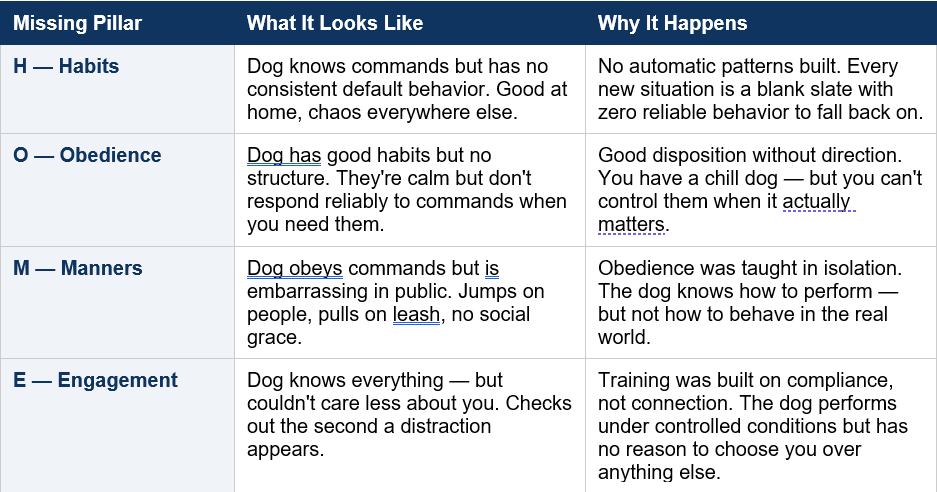
Here's what it looks like when each pillar is the weak point:

See the pattern? Each missing pillar creates a very specific type of failure. And here's the kicker — most owners don't even realize which pillar is missing until they're standing in the middle of a mess, wondering why their "well-trained" dog just embarrassed them at the neighborhood barbecue.
The Storm Test: When Distractions Expose the Cracks
Here's something we see over and over again: a dog that's absolutely stellar in a quiet training environment. They nail every command. They're focused. They're responsive. Their owner is thrilled.
Then they go to the dog park. Or a family reunion. Or a busy pet store. And suddenly — poof. Everything falls apart.
That's the storm test. And a structurally weak foundation always fails it.
Distractions aren't the enemy. They're the inspector. They show up and check every load-bearing wall. If your dog's training has a weak pillar, a distraction will find it. Another dog, a loud noise, a stranger walking up to your front door — these are the storms that separate a truly well-built dog from one that just looked good on paper.
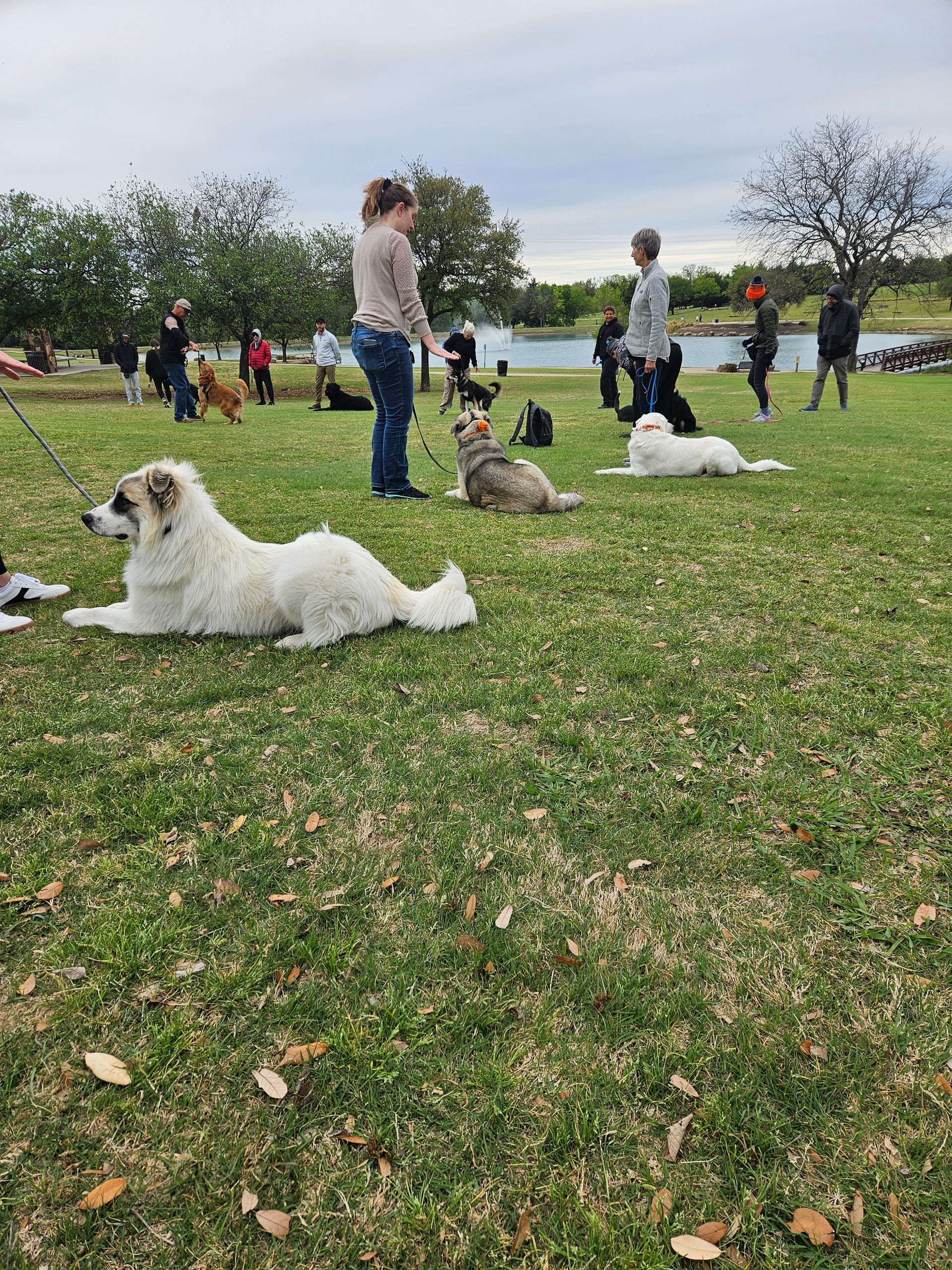
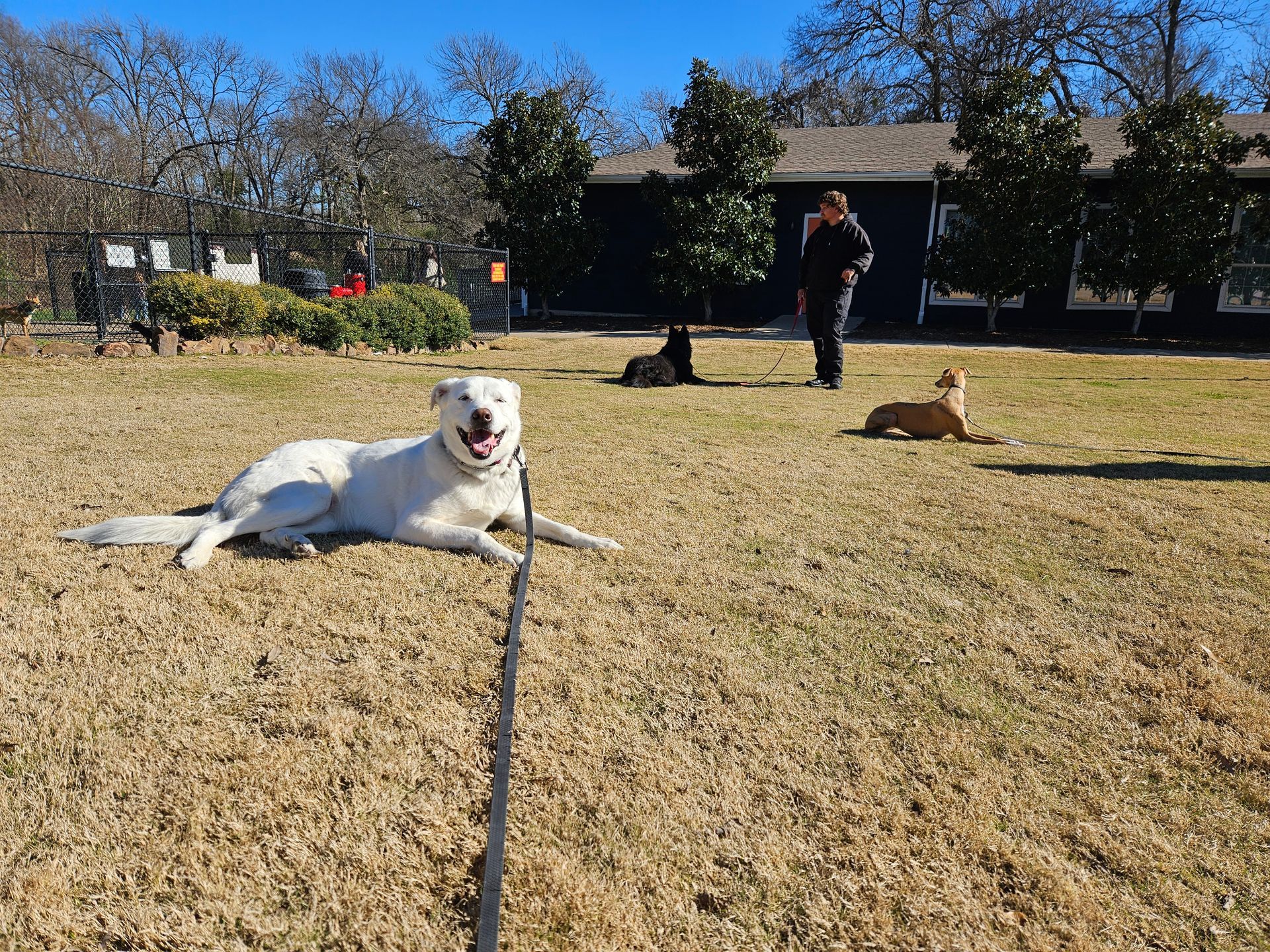
And that's exactly why, after a board and train or day train program is completed, we move our clients into Group Classes.
Think of it as a stress test for your dog's structure — we put them in a real environment with real distractions and watch for the cracks. Where a joint is loose, we tighten it. Where a gap shows up, we close it. By the time you're done, you're not just leaving with a trained dog — you're leaving with one that's been tested, reinforced, and built to hold up when it counts.
Why Most Dog Trainers Miss This Entirely
Most dog training programs focus almost exclusively on obedience — the commands, the tricks, the performance. And look, obedience matters. It's one of our four pillars for a reason.
But obedience without habits beneath it is framing without a foundation. It looks impressive until the first real test.
And engagement? Most trainers don't even address it directly. They assume that if the dog is performing the commands, the relationship is solid. But that's like assuming your roof is waterproof just because it looks good on a sunny day. You don't know until the rain hits.
This is exactly why we built The HOME Method™ dog training system the way we did — not to add complexity, but to make sure that when we train your dog, we're building something that actually lasts.
What This Means for You and Your Dog
Our goal has always been simple: we want you to have a dog that is a joy to live with — not a frustration to manage.
That doesn't happen by teaching commands in isolation. It happens by building all four pillars — Habits, Obedience, Manners, and Engagement — in the right order, with the right foundation, and with enough depth that your dog can handle the real world without falling apart.
We don't just train dogs at H.O.M.E. Dog Training. We build dogs — structurally sound, storm-tested, and built to last.
Ready to inspect your dog's foundation?
Contact H.O.M.E. Dog Training today and let's find out which pillar needs attention — before the next storm does it for you.
———————————————————————
About H.O.M.E. Dog Training
Where Habits, Obedience, Manners & Engagement Come Home.
H.O.M.E. Dog Training is a veteran-owned, family-operated business based in Rockwall, Texas — and when we say family, we mean it. It's my wife, our son Wyatt, and me. That's it. No staff. No revolving door of employees. No one else's hands on your dog but ours.
Every dog that comes through our program gets our hands-on attention — not a handoff. We work with each dog individually, we get to know their personalities, and we build on the four pillars that make up everything we do: Habits, Obedience, Manners, and Engagement. Those four pillars aren't just a name — they're the system we use to transform the way your dog shows up in your life every single day.
We serve the DFW metro area and East Texas, and we're here every day — because consistency is one of the things that makes real training work. A small business. A big commitment. And a family that genuinely cares about your dog and your peace of mind.
Keywords: dog training, dog training near me, dog obedience training, dog training Rockwall TX, dog training DFW, dog trainer, dog habits, dog manners, dog engagement, how to train your dog, dog training tips, professional dog training, H.O.M.E. Dog Training

Recent Posts