

Board and Train
Board & Train Dog Training in Rockwall, Texas
Your dog lives and trains with us Monday through Friday. He comes home to you every weekend.
Board & Train is for the dog who needs more repetitions than a working family can realistically get to.
Day & Train works because the family does the reps between sessions. Some families genuinely don't have the time — the job, the kids, the week that got away from them. That's not a character flaw. It's a schedule. So we do the repetitions instead.
But he still comes home every weekend, because a dog who only listens to us is a trick, not training.
We train out of our home in Rockwall. It's Charles, Laura, and our son Wyatt — the same hands on your dog from the first day to the last. No rotating staff. No handoffs. No trainer you've never met working your dog on Thursday.
How the week works
Monday morning, 6:30 to 9:00 AM — drop-off. We want everyone here by nine so the day can start.
Monday through Friday — your dog lives and trains with us.
Friday afternoon — pickup and your lesson. Scheduled between 3:30 and 6:30. You stay for 45 to 60 minutes, and we teach you what we taught your dog that week. Then you do it, with him, while we watch.
Every weekend, at home with you. Two homework sessions Saturday, two Sunday. You go home with the homework book, you write down what happened, and we adjust the next week's training based on what you tell us.
That's the part most programs skip. There's no big reveal at the end — no three-hour marathon lesson where we hand you a trained dog and a list of instructions and wish you luck. Nobody retains three hours of information, and no dog stays interested that long either. You learn it a week at a time, right alongside him.
If you're traveling, we'll board him over the weekend and schedule a makeup lesson. Nobody loses a week.
What a training day looks like
6:30 AM — first potty walk
7:00 AM — breakfast
8:30 AM — training starts
Then the rhythm: 20 to 30 minutes of work, 50 to 60 minutes off. All day long.
The break isn't downtime we're filling. A dog who works straight through stops absorbing and starts enduring, and a dog who's enduring isn't learning anything you want him to keep. The rest between sessions is where what he just learned actually settles.
End of the day — dinner, then play. No rules, no drills. Just a chance to burn off what's left and be a dog.
7:30 to 8:00 PM — last potty walk.
By then most of them are done. They sleep hard, because they earned it.
Where your dog actually trains
Not one room. That's the point.
Inside our home — because that's where your dog's problems happen. Doorways, kitchens, couches, guests coming in.
Our three-quarter-acre backyard — space to work recall, distance, and distraction.
Our training building — heated and air conditioned, for the 105-degree August afternoons, the January cold snaps, and the torrential Texas downpours that show up without warning. Weather never costs your dog a training day.
Out in the world — downtown Rockwall, downtown Royse City, downtown Fate, local parks and hiking trails.
Dogs are fantastic at associating and lousy at generalizing. A dog who's flawless in one place has learned that place. Field trips aren't for show and tell — they are for information and development. We're not building a dog who's impressive at our house. We're building one who works in yours, and everywhere your family goes.
Where your dog sleeps
This is the question everybody has and most people are too polite to ask. Here's the whole answer.
We have a detached three-car garage connected to our house by a breezeway. We gutted it and built it out for the dogs.
- Eight kennels. That's the whole capacity. Not a row of a hundred.
- Six feet by four feet, each one.
- Its own dedicated heating and air system — set cooler than we'd keep a house, because dogs are comfortable where people aren't.
- Two air scrubbers running continuously to keep the air clean.
- Professional epoxy flooring, so the room stays genuinely sanitary and doesn't hold odor.
- Fully sanitized every weekend. Fresh food and water bowls every single day.
- A refrigerator dedicated to the dogs, for anyone on refrigerated food.
- A temperature monitor we can see from anywhere inside our house.
It sits eighteen feet from our back door. If a dog barks, we hear it. We check on them through the evening.
We don't crate. The only exception is a family actively crate training who asks us to continue it — then we do, because consistency matters more than our preference.
What to bring
- His food, and any medications
- His bed, if you'd like him to have it
- A couple of favorite toys for his kennel at night
Vaccinations: your dog needs to be current on standard annual vaccinations, plus Bordetella. Send us a copy from your vet before drop-off and you're set.
If your dog gets sick or hurt
We call you first and immediately.
If we can't reach you, he goes to our vet — seven minutes from the house, and the same vet our own dogs see.
Come see him whenever you want
You're welcome here anytime. Just call or text first so you don't make the drive on a morning he's in downtown Rockwall or out on a trail.
Call to check on him whenever you'd like, too. But that's also why we send video Tuesday and Thursday nights instead of a text saying he's doing great.
You can fake a picture. You can't fake an unedited video. We want you to watch him work — his demeanor, his personality, what he's learning, and how much fun he's having doing it.
He's not going to be miserable without you
This is the worry nobody says out loud, and it's worth answering directly.
Dogs don't sit up crying at night here. They're more physically and mentally active than they've ever been in their lives — training, field trips, new places, new people, play at the end of the day. By 8:00 PM they're spent, and they sleep like it.
And he comes home to you every single weekend. He's never gone more than five days.
About play
Dogs who enjoy other dogs get to play at the end of the day. We're always out there with them — every time. Not for supervision alone. Play is training. Some dogs play too rough and need to learn where the line is. Some will only relax enough to play if a person they trust is standing there.
Some have habits — mounting, mostly — that start fights they never meant to start, and a dog who learns to knock that off is a dog with a much easier life around other dogs.
Dogs who aren't comfortable with other dogs play with us instead. Every dog ends his day the same way: having had a good time.
The Four Pillars
Every dog gets all four. A dog missing one falls apart in real life no matter how good the other three look.
Habits — what your dog does before you say anything. The default settings.
Obedience — a shared language, not a list of tricks.
Manners — what makes a dog a joy to live with instead of something to manage.
Engagement — your dog choosing you over the distraction.
There is a big difference between a dog obeying a command and a dog that didn't need one.
You'll see it happening
Video updates Tuesday night and Thursday night, every week.
Not a highlight reel at the end. You see what we're working on that week, how he's responding, and where he is right now. You'll see that he's happy, that he's healthy, and — this is the part families tell us they didn't expect — that he's crazy about his trainer.
Program lengths
2 Weeks — for the dog who's simply untrained. He doesn't know the words, he drags you down the sidewalk, he mugs guests at the door. No emotional component underneath it, just a dog nobody ever taught. Two weeks builds the Foundation and gives you the Structure to keep it going.
3 Weeks — the most common. Everything in the two-week program, plus the time to work through mild to moderate anxiety, leash reactivity, and dog reactivity — and to proof it all in real environments before he comes home for good. Most dogs belong here. It's where the training stops being something he does at our house and starts being something he does.
5 Weeks — for severe anxiety, severe reactivity, or human aggression. These dogs aren't disobeying. They're responding emotionally, and until that changes, obedience is just a thin layer over the same dog. Confidence has to come first, and there's no shortcut for how long that takes. Five weeks is also the right call for a family wanting real off-leash dependability in hard environments.
Which one fits depends on where your dog is starting, not on which package looks best. We'll tell you honestly on the phone.
What if he needs more time
Occasionally a dog does. It's rare, and we'd know by the halfway point — not spring it on you at the end.
When it happens, it's almost always a dog whose issues are emotional rather than behavioral: reactivity, anxiety, real fear. You can't move a dog faster than his emotions can go. Push a dog like that to hit a calendar date and he shuts down, and then you've undone the actual work.
So the honest answer is that we'd rather tell you at week two that he needs another week than hand him back on schedule and let you find out at home.
What we don't do is give up on a dog. Our job is to pick the right program at the start, and we take that seriously — because the program length is the first real decision either of us makes.
After the program ends
Group classes are included for the life of your dog. Not for a month, not as a package add-on. For his life.
Twice a month at a 68-acre park in Rockwall, second and fourth Saturdays at 9:00 AM.
This is practice — the same reason any team practices. Skills don't stay sharp because someone learned them once. They stay sharp because they get used, in front of distractions, around other dogs, on a day when your dog would rather be doing something else.
Come every time. Come twice a year. Come when something's slipping and you want eyes on it. The door doesn't close.
Who we work with
A
ll breeds, all sizes, puppies through adult dogs with years of habits already built. Leash pulling, jumping on guests, door manners, leash reactivity, dog reactivity, human reactivity, recall, counter surfing, door dashing, resource guarding, and anxiety.
We don't train service dogs or protection dogs. We train family dogs — dogs you can take places.
Families come to us from Rockwall, Heath, Royse City, Fate, Rowlett, Garland, Forney, and across North and East Dallas. Board & Train is also the program families travel for — we've had dogs come to us from well outside DFW, and out of state.
Call us and talk about your dog
Not a form. Not a sales call. You'll be talking to on of us who would actually be training him.
Tell us what's going wrong — the walk, the door, the thing you've stopped doing because of him. We'll tell you honestly what we think is happening and whether Board & Train is the right fit, or whether Day & Train would serve you better.
We're typically booking five to seven weeks out. If you know you want a spot, it's worth calling sooner rather than later.
972-245-3386 — call or text.
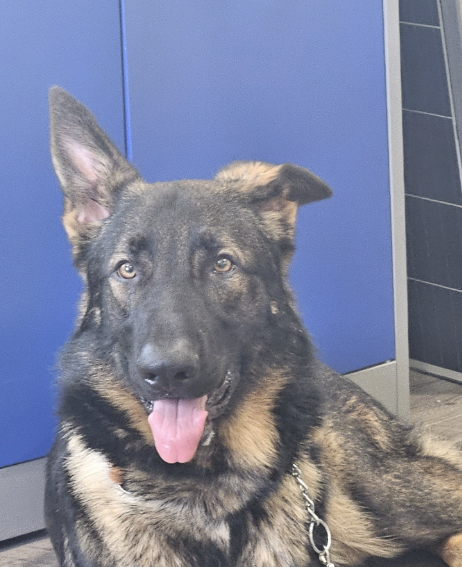
Meet Maverick
We were Maverick's third trainer.
He was a year and a half old, 90 pounds of German Shepherd, and he lunged at all people. He'd never made contact yet — but only because his dad was strong enough to stop him with the leash every single time.
The first trainer threw bags of coins at him to stop the aggression (that didn't work). His dad quit after a couple of lessons. The second company worked with him at the family's home once a week for twelve weeks. In three months, that trainer was never once able to walk him on a leash.
By the time they called us, they were afraid of what he might do. Not embarrassed — afraid. Afraid he'd get to someone before the leash stopped him. They couldn't walk their two dogs together. And having people over had quietly become something they didn't do anymore.
That's when they were referred to us.
The severity meant I wanted to see him in person before I recommended anything. When his dad pulled into the driveway, Maverick tried to come out of that car and attack me. Not bluster. He meant it.
Ninety minutes later, I was walking him on a leash. He wore a muzzle and I wore bite sleeves, and I want to be honest about what that ninety minutes actually was: he wasn't comfortable. He was allowing it. And it took all of those 90 minutes to EARN his trust enough to walk with him.But he'd stopped losing his mind at the sight of me, and that was the whole question — could he get to a place where he could think. His dad said something at the end of that session I've thought about since. "You've done more in ninety minutes than two trainers did in four months. None of them could or would even touch his leash."
We put him in a five-week Board & Train.
I asked him to plan on ninety minutes at drop-off, expecting we'd need to rebuild everything from the evaluation before he could leave. We didn't. Forty-five minutes in, I told him he could go.
He kept the muzzle on most of that first day. Three-quarters of the way through, we took it off. Still leery, still uncomfortable — but letting me leash him, unleash him, handle him, work with him. I kept the sleeves on anyway. He'd earned the benefit of the doubt, not the whole thing. Experience comes with scar tissue, and I have enough experience to not be cavalier about Maverick's potential.
Day two, he settled into the routine and figured out that I was the guy who kept doing interesting things with him. That's when it got clear.
Maverick was not an inwardly aggressive dog. He was a frightened one that was doing the only thing he knew how to do to make "danger" go away.
He'd missed his socialization window as a puppy, and he'd been leaning on his housemate — another German Shepherd — for confidence he didn't have himself. Strip that away and put him in front of a stranger and he did the only thing he knew: get big and get mean first.
So we built the confidence he was missing. New textures under his feet. New objects. New sounds. New people at a distance he could handle, then a little closer, then closer. Nothing that put him somewhere he couldn't cope.
By week three we were doing field trips to Home Depot and stores around Rockwall.
In his final week, a man in a store asked if he could meet him — Maverick's a beautiful dog and people notice. I told him the truth: this dog is here for aggression, he may snap, and I'll let him come to you only if he chooses to. If he doesn't, we walk away.
Maverick chose to. He walked over and let a complete stranger scratch him. First time in his life.
That same week was the Fourth of July. His family had people over — family, friends, a backyard barbecue, the exact thing they'd stopped attempting. Maverick did great. He still had a full week of training left.
By the end of those five weeks, any of us could handle him — me, Laura, Wyatt. He walked calmly around other dogs. He turned out to be a tremendous worker who loved having a job, and one of the more enjoyable dogs I've spent time with.
None of that was hiding under the aggression. The aggression was hiding the dog. — Charles
Dog Training FAQs
-
DO YOU USE e-COLLARS OR SHOCK COLLARS?
At Home Dog Training, we believe in clarity, not confusion. eCollars often create unnecessary frustration for both dog and owner—especially when timing or settings are off. That confusion can ripple into your relationship and make learning harder, not easier.
Our philosophy is simple: if a dog doesn’t understand what we’re asking, the answer isn’t to “turn up the pressure”—it’s to communicate better. We train without shortcuts or fear, focusing instead on trust, structure, and consistent communication.
-
WHAT TYPE OF TRAINING DO YOU OFFER?
We’re pet dog trainers serving families across Texas and
Oklahoma—and now proudly based in Rockwall, TX. We train all breeds
and sizes, from puppies to adults, and specialize in:
- Obedience and Manners
- Real-World and Community Skills
- Behavior Modification
- Anxiety and Aggression
We don’t train service or protection dogs, but we do help families build confident, happy companions they can enjoy anywhere. If you had to give us a label, we’d call ourselves rewards-based, relationship-focused trainers—because great training starts with great connection.
-
WHAT IS REWARDS-BASED TRAINING?
Our Reward-Based Training Philosophy
We use reward-based training methods that work with your dog's natural psychology, not against it. Think of it like this: would you rather work for a boss who yells at you for mistakes, or one who celebrates your wins and helps you understand what success looks like?
Your dog feels the same way. By rewarding the behaviors we want to see, we build your dog's confidence, strengthen their desire to work with you, and create lasting results. They need to not fear making a mistake, for without mistakes, it is hard to show them the correct path.
This approach is incredibly effective. When dogs understand that good choices lead to good outcomes, they become eager problem-solvers who want to make the right decisions. We teach impulse control, focus, and engagement through positive reinforcement, building a foundation where your dog listens because they want to, not because they're afraid of what happens if they don't. After years of training over 2,000 dogs, we've seen firsthand that reward-based training creates dogs who are confident, happy, and genuinely enjoyable to live with.
-
HOW WILL I BE UPDATED ON MY DOG’S PROGRESS?
We know how important it is to feel connected to your dog’s journey. That’s
why we send regular video updates each week—so you can see their training, tail wags, and growing confidence.
Most trainers MAY send a weekly email update with a picture, but we want you to feel as close to the process as possible. After all, this isn’t just your dog’s transformation—it’s your family’s.
-
WHAT SHOULD I EXPECT DURING MY DOG’S EVALUATION?
An evaluation isn’t a test—it’s a conversation. It’s our chance to meet your dog, observe their behavior and temperament, and talk about your goals and lifestyle. We’ll discuss training methods, answer your questions, and
help you see what’s possible. Trust your instincts. The right trainer should feel like a partner who truly understands both you and your dog.
-
IS IT OK TO SAY “NO” OR GIVE CORRECTIONS?
Yes—but how you do it matters. Just like with kids, boundaries help dogs feel safe and guided. A calm, firm “no” or gentle redirection gives clarity without fear.
We don’t correct out of frustration—we communicate to teach. Dogs thrive on consistency and structure, and fair corrections (balanced with praise and play) help them understand where they fit in your world.
-
CAN YOU CUSTOMIZE TRAINING FOR MY DOG?
Absolutely. Every dog and every family is different. During your free evaluation or discovery call, we’ll learn what matters most to you—whether
it’s polite leash manners, calm behavior around guests, or better focus outdoors.
We then customize your program to fit your goals, schedule, and lifestyle.
-
WHAT IS YOUR MOST POPULAR TRAINING PROGRAM?
Our Board and Train program is by far the most popular—and for good reason. Dogs live and train with us in a structured environment that helps them learn faster and more consistently.
We also offer our Day and Train program— for the fully committed, Heavily Involved owner who loves being hands-on. Your dog trains with us two days a week, and you get five days of guided homework to solidify what they’ve learned.
It’s designed for the owners who want to be part of the process every step of the way.
And just to be clear—we don’t call anything a “Boot Camp.” We’re a veteran-owned company, and our programs are about joy and progress, not a military style boot camp.
-
DO I HAVE TO COME TO A FACILITY?
Not anymore! We’ve moved home to Rockwall, TX, where we train dogs on our 1.5-acre property.
You can book over the phone for most obedience programs or schedule a Free Lesson first, whichever you prefer. For behavioral or emotional issues, we need to meet your dog in person to assess what’s best.
We still encourage every dog owner to visit any trainer before committing—see where your dog will live, learn, and rest.
Transparency builds trust. And for those that want to visit, we include not just an evaluation when we meet, but a Free First Lesson when we meet.
-
WHICH IS BETTER: A FACILITY OR A TRAINER’S HOME?
After years of running America’s largest indoor dog training facility, we learned something important: dogs don’t need a warehouse to grow—they need calm, clarity, and connection.
Training from our home in Rockwall allows us to work one-on-one with each dog, without the chaos or noise of a large facility. Your dog learns in real-world settings—inside a home, out on the property, and in the community—just like life with you.
-
WHAT RED FLAGS SHOULD I WATCH FOR WHEN CHOOSING A TRAINER?
Be wary of any trainer who relies on fear, pain, or quick fixes.
Avoid those who insist or require the use of eCollars or make unrealistic promises. Those types of trainers often make your Dog pay the price for THEIR promises.
Always ask to see them working with another client’s dog—not just their demo dog.
Look for happy, engaged dogs who are learning with enthusiasm and trust. That’s the biggest sign you’ve found the right trainer—someone who genuinely cares about both ends of the leash.
-
IS DOG TRAINING STRESSFUL FOR MY DOG?
Learning something new always comes with a little challenge, but it shouldn’t create fear. We keep training playful and engaging so dogs stay curious and motivated.
We balance structure with joy—because every game has rules, and through structured play, dogs naturally learn boundaries, focus, and confidence.
Our goal is simple: a dog who loves to learn and a family who loves living with them.