Puppy 911: What to Expect During the First Month With Your New Puppy
Bringing home a new puppy is exciting.
Then the puppy cries in the crate, pees on the floor, bites your hands, chews the furniture, follows you everywhere, wakes up at night, and suddenly seems to have completely forgotten everything you thought they learned yesterday.
Welcome to puppyhood.
At
HOME Dog Training in Rockwall, Texas, we work with puppies and their owners throughout Rockwall, surrounding communities, North and East Dallas, and the Dallas metro area. One of the most important things we teach new puppy owners is simple:
Your puppy doesn't need to be perfect. Your puppy needs to start developing the right habits.
The first weeks aren't about creating a finished dog. They're about establishing routines, communication, confidence, and expectations that will make everything you teach later easier.
Our
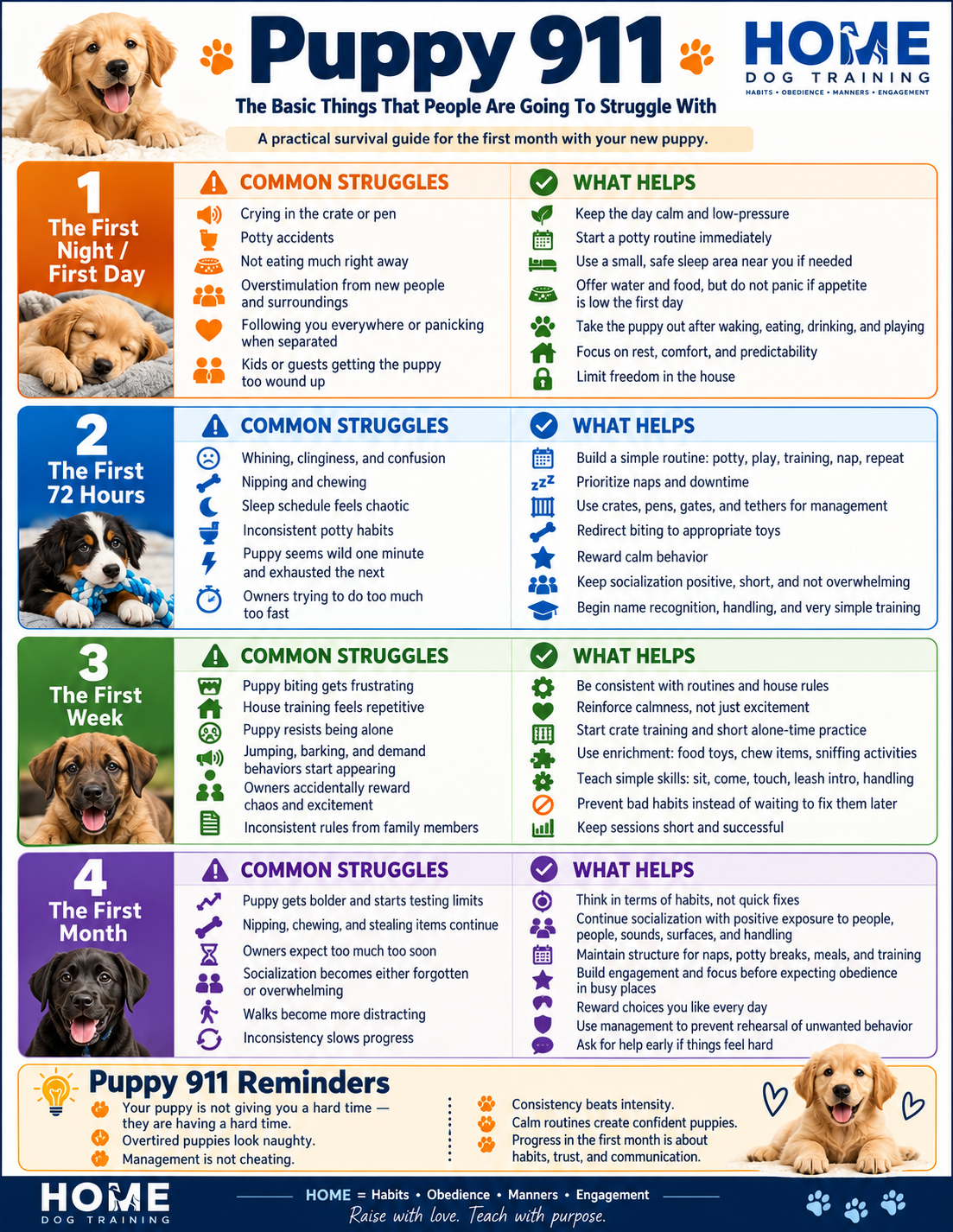
Puppy 911 guide breaks that first month into four stages.
The First Night With a New Puppy
The first night can be difficult for both the puppy and the owner.
Your puppy may cry in the crate or pen, have potty accidents, eat very little, follow you constantly, or become overwhelmed by all the attention from an excited family.
That doesn't necessarily mean anything is wrong.
Think about what just happened from the puppy's perspective.
They were removed from the environment, littermates, people, smells, sounds, and routines they knew and suddenly placed somewhere completely unfamiliar.
The first night should be about predictability, not perfection.
Keep things relatively calm. Establish a potty routine immediately. Provide an appropriate sleeping area, and don't give a brand-new puppy unlimited freedom throughout the house.
One of the biggest mistakes new puppy owners make is giving
too much freedom too soon.
Freedom should grow with reliability.
What Should You Expect During the First 72 Hours With a Puppy?
During the first three days, many puppies begin showing more of their personality.
You may see:
- Puppy biting and chewing
- Whining or clinginess
- Difficulty settling
- Inconsistent potty habits
- Bursts of wild puppy energy followed by exhaustion
- Confusion about sleeping and routines
This is where structure begins becoming extremely valuable.
A puppy's day doesn't need to be complicated.
Potty. Play. Train. Rest. Repeat.
Young puppies need tremendous amounts of sleep. An overtired puppy can often look like a puppy that needs
more exercise when what they actually need is help settling down.
Crates, exercise pens, gates, and tethers can all help manage a puppy's environment while they're learning.
Management isn't cheating.
It's how we prevent a puppy from repeatedly practicing behaviors we don't want.
How Do You Stop Puppy Biting?
Puppy biting is one of the most common questions we hear from new puppy owners.
Biting, mouthing, and chewing are normal puppy behaviors. Your job isn't simply to keep saying
“NO.”
Instead, start teaching the puppy what they should do with their mouth.
Redirect biting toward appropriate toys and chews. Reward desirable choices. Provide appropriate outlets for chewing and play.
And pay attention to when the biting gets worse.
If your puppy turns into a tiny land shark every evening, exhaustion and overstimulation may be contributing to the behavior.
Don't just referee bad behavior. Teach the game you actually want your puppy to play.
The First Week: Habits Start Forming Quickly
By the first week, many owners feel like they're repeating themselves constantly. That's because they are.
And that's okay.
Potty training requires repetition.
Crate training requires repetition.
Learning to be alone requires repetition.
Learning not to jump requires repetition.
Learning that hands aren't chew toys requires repetition.
Your puppy isn't failing because you have to practice something again tomorrow.
They're learning.
At HOME Dog Training,
Habits is the first pillar of our training philosophy for a reason.
HOME stands for:
Habits • Obedience • Manners • Engagement
Before worrying about advanced obedience, we want puppies learning how to successfully live with their families.
Calmness Is Something Puppies Can Learn
Owners of energetic breeds frequently tell us:
“My dog just isn't a calm dog.”
Energy and calm behavior are not opposites.
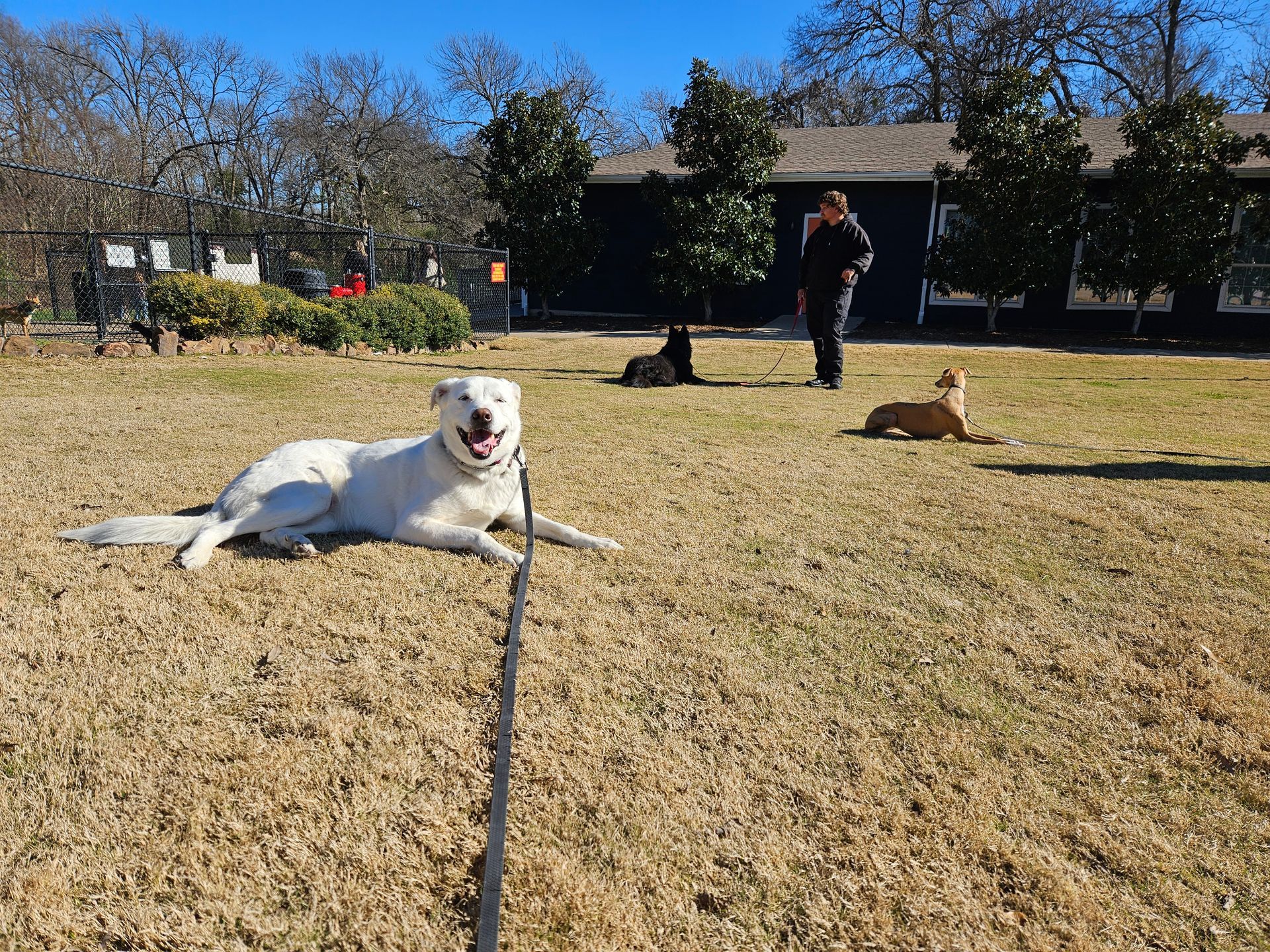
A high-energy Labrador, German Shepherd, Belgian Malinois, Golden Retriever, Doodle, or mixed-breed puppy can learn that there are appropriate times to run and play—and appropriate times to settle.
You don't necessarily need to eliminate energy.
Want to see what that looks like in real life?
Watch our 5-month-old Belgian Malinois, Gabby, go from crazy Frisbee play outside to calmly relaxing beside our 9-month-old granddaughter playing with the exact same Frisbee. Same dog. Same Frisbee. Different rules.
▶ [Watch Gabby demonstrate calm behavior]
You need to teach the puppy
where and when different behaviors are appropriate.
Reinforce calmness instead of only interacting with your puppy when they're excited.
If excitement is the only behavior that consistently earns engagement from humans, puppies can become extremely good at being excited.
Dogs become good at what they practice.
What Should a Puppy Learn During the First Month?
The first month isn't about seeing how many obedience commands you can teach.
Simple skills are plenty.
Name recognition, sit, come, handling, leash introduction, engagement, and beginning impulse control can all be introduced through short, successful training sessions.
Three to five minutes of productive puppy training can accomplish far more than dragging a distracted puppy through a long training session.
More importantly, begin establishing
household habits.
Where does the puppy sleep?
What happens at doors?
Is jumping rewarded with attention?
Can the puppy settle while the family eats?
What happens when guests arrive?
Does pulling get the puppy where they want to go?
These everyday behaviors ultimately determine what it's like to
live with your dog.
Puppy Socialization Does Not Mean Meeting Everyone
This is another area where puppy owners often receive confusing advice.
Socializing a puppy doesn't mean your puppy needs to greet every person and play with every dog.
Exposure and interaction aren't the same thing.
A puppy can see another dog without meeting it.
A puppy can watch children playing without joining them.
A puppy can hear construction equipment without investigating it.
A puppy can see a stranger without needing attention from them.
Good puppy socialization should help build confidence while also teaching
environmental neutrality.
We want puppies capable of experiencing the world without believing everything in that world requires a response.
That's especially important as puppies mature.
Why Is My Puppy Suddenly Testing Boundaries?
As puppies become comfortable in their new homes, owners frequently say:
“They were so good the first week. What happened?”
Often, nothing went wrong.
The puppy simply became more comfortable.
Confidence increased.
Now they're experimenting.
Can I jump on this?
Can I steal that?
What happens if I bark?
Does pulling get me where I want to go?
What happens when I ignore that request?
This is why consistency matters.
Puppies are constantly gathering information about how their world works—even when you don't realize you're teaching them.
Every repeated behavior is practice.
Don't Wait for Bad Habits Before Teaching Good Ones
Dog training often becomes reactive.
The puppy jumps, so we address jumping.
The puppy pulls, so we address pulling.
The puppy steals food, so we address counter surfing.
The puppy runs out the door, so suddenly we're worried about doorway manners.
There's a better approach.
Ask yourself:
“What do I want my adult dog to do in this situation?”
Then begin teaching that behavior while they're still a puppy.
Don't wait until a behavior becomes frustrating before deciding what you would rather have the dog do.
That's the difference between constantly
managing problems and intentionally
building habits.
When Should You Get Professional Puppy Training?
You don't necessarily need to wait until your puppy has developed serious behavior problems before working with a professional dog trainer.
Early puppy training can help owners understand:
- Potty and crate training
- Puppy biting and chewing
- Leash skills
- Recall
- Engagement
- Impulse control
- Household manners
- Appropriate socialization
- Environmental neutrality
- Preventing unwanted habits
- Building reliable obedience as the puppy matures
Professional training shouldn't simply teach your dog commands.
It should teach
you and your dog how to communicate with each other.
Puppy Training in Rockwall, Texas
HOME Dog Training is a family-operated dog training business based in Rockwall, Texas, serving dog owners in Rockwall and surrounding communities, North and East Dallas, and across the Dallas metro area.
Our training philosophy is built around four elements:
Habits. Obedience. Manners. Engagement.
We believe good dog training should create dogs that can function in the real world—not dogs that only perform when they're standing in a quiet kitchen with a treat in front of them.
That means teaching skills around real distractions, helping owners understand how and why their dogs learn, and building behaviors that transfer back into everyday family life.
Because ultimately, most families aren't looking for a dog that can simply perform commands.
They want a dog they can enjoy living with.
Need Help With Your New Puppy?
Bringing home a puppy shouldn't feel like you're figuring everything out through trial and error.
If you're struggling with
puppy biting, potty training, crate training, chewing, jumping, leash skills, socialization, or simply getting your puppy into a good daily routine, our
Puppy Foundations Online Course was created to help.
We walk you through the same foundational concepts we use at
HOME Dog Training to help you understand what to teach, how to teach it, and—just as importantly—how to prevent frustrating puppy behaviors from becoming long-term habits.
Start building the dog you want to live with today.
👉
[Start the Puppy Foundations Online Course]
Frequently Asked Puppy Training Questions
Is puppy biting normal?
Yes. Mouthing, biting, and chewing are normal puppy behaviors. Owners should provide appropriate outlets, redirect inappropriate biting, reinforce better choices, and consider whether fatigue or overstimulation is contributing to excessive biting.
How often should I take my puppy outside to potty?
Young puppies generally need frequent potty opportunities, particularly after waking, eating, drinking, playing, and training. Consistency and supervision are important during house training.
Should my puppy meet every dog and person for socialization?
No. Puppy socialization can include calmly experiencing people, dogs, sounds, surfaces, environments, and other stimuli without direct interaction. Neutrality is an important social skill.
Can a high-energy puppy learn to be calm?
Yes. Energy level and calm behavior are different things. Owners can intentionally reinforce settling, impulse control, household manners, and appropriate outlets for energetic behavior.
When should puppy training begin?
Learning begins immediately. Owners can begin establishing routines, name recognition, engagement, handling, potty habits, boundaries, and simple age-appropriate training as soon as the puppy comes home.
What is the HOME Dog Training method?
HOME represents
Habits, Obedience, Manners, and Engagement. The approach focuses on developing everyday behaviors and communication that help dogs and their owners function successfully together in real-life environments.
The Puppy 911 Rule to Remember
Your puppy is going to make mistakes.
Probably lots of them.
The objective during the first month isn't perfection.
It's progress.
Consistency beats intensity.
Build calm routines. Reward the behaviors you want repeated. Prevent unwanted behaviors from becoming rehearsed habits. Teach your puppy how to communicate with you.
And remember:
Your puppy isn't just learning SIT, DOWN, and COME.
They're learning
how life with you works.
HOME Dog Training
Rockwall, Texas
Habits • Obedience • Manners • Engagement
Raise with love. Teach with purpose.